
What Is an Easy Grader?
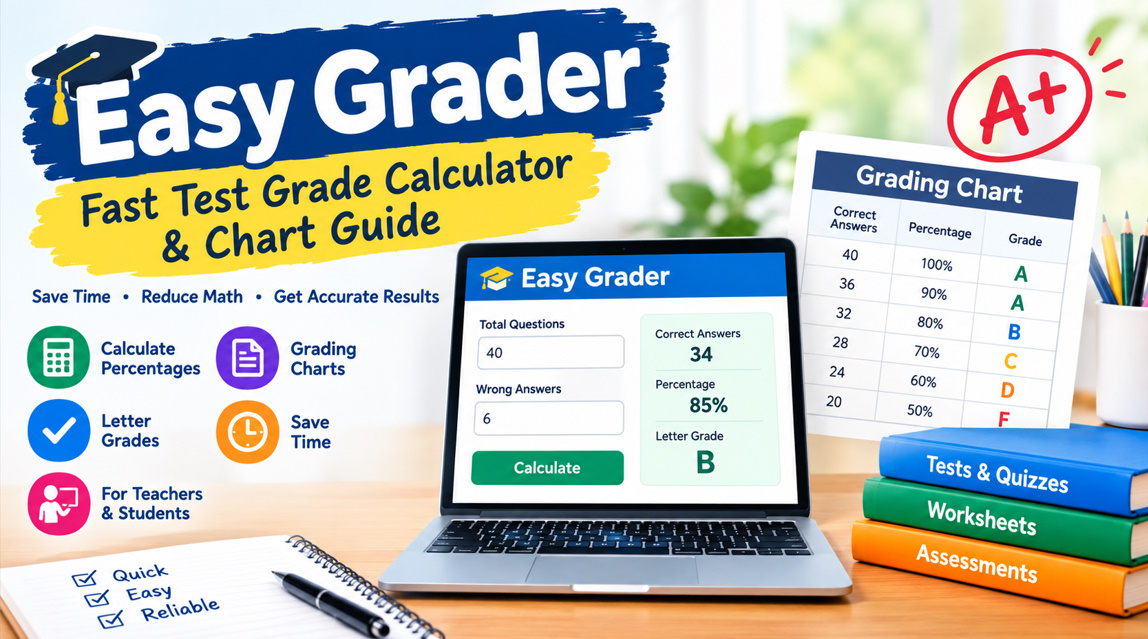
An Easy Grader is a simple grading calculator designed to make test and quiz scoring faster. Instead of manually calculating percentages for every paper, teachers can enter the total number of questions and incorrect answers to determine the score quickly. It is especially useful for objective assessments with equally weighted questions.
The term EZ Grader is also commonly used for traditional grading charts and digital grading calculators. These tools help convert correct or incorrect answers into percentages and, depending on the grading scale, letter grades. This makes repetitive classroom grading easier and reduces unnecessary arithmetic.
- Online grade calculator
- EZ Grader tool
- Test score calculator
- Percentage grader
- Teacher grading tool
- Quiz grade calculator
- Automatic grade calculator
- Classroom grading assistant
How Does an Easy Grader Work?
An Easy Grader generally uses a straightforward calculation. First, the number of wrong answers is subtracted from the total number of questions to determine the correct answers. The correct answers are then divided by the total questions and multiplied by 100 to calculate the percentage score.
For example, if a quiz contains 25 questions and a student misses 3, the student has 22 correct answers. The percentage is calculated as 22 divided by 25, multiplied by 100, resulting in an 88% score. The final letter grade depends on the grading scale being used.
- Enter total questions
- Enter wrong answers
- Calculate correct answers
- Determine the percentage
- Apply the grading scale
- Review the final score
- Check letter grade
- Record the result
Easy Grader Formula Explained
The basic Easy Grader formula is simple enough to understand without advanced mathematics. Correct Answers = Total Questions − Wrong Answers. After finding the number of correct answers, use Percentage = (Correct Answers ÷ Total Questions) × 100 to determine the test percentage.
Suppose a student answers 47 questions correctly out of 50. Dividing 47 by 50 gives 0.94, and multiplying by 100 produces a 94% score. A grading calculator performs these steps automatically, allowing educators to focus on reviewing student work rather than repeating calculations.
- Total questions
- Wrong answers
- Correct answers
- Percentage score
- Grade calculation
- Standard formula
- Score conversion
- Final result
Why Teachers Use Easy Grader Tools
Teachers often grade multiple quizzes, worksheets, and objective tests at the same time. Performing the same percentage calculation repeatedly can take considerable effort. An Easy Grader simplifies this process by providing a quick way to convert the number of mistakes into a final percentage.
A digital EZ Grader can also improve consistency because the same mathematical formula is applied to every score. Some grading calculators can produce complete grading charts, allowing teachers to identify the percentage associated with different numbers of incorrect answers without calculating each result individually.
- Saves grading time
- Reduces repetitive calculations
- Supports consistent scoring
- Simplifies quiz grading
- Helps grade tests faster
- Reduces arithmetic mistakes
- Creates quick score references
- Improves grading workflow
Easy Grader for Teachers, Students, and Tutors
Easy Grader tools are useful for more than classroom teachers. Students can use a grade calculator to understand their performance after a practice quiz or test. Tutors can use one to calculate scores during study sessions, while parents can use it to understand basic test percentages.
The tool is particularly convenient when every question carries the same value. It provides a quick overview of performance without requiring a spreadsheet or manual percentage calculation. However, assignments with different point values may require a points-based or weighted grade calculator instead.
- School teachers
- College instructors
- Private tutors
- Homeschool educators
- Students
- Parents
- Online educators
- Academic support staff
Easy Grader vs. Manual Grade Calculation
Manual grading requires the user to count correct answers, determine the total number of questions, perform the percentage calculation, and then interpret the result using the appropriate grading scale. While this method works, repeated calculations can become tedious when many papers need to be graded.
An Easy Grader automates the arithmetic portion of this process. A teacher can enter the required information and quickly obtain the result. The main advantage is convenience rather than a different mathematical method, because both manual grading and digital grading calculators rely on the same underlying percentage formula.
- Manual calculations take longer
- Digital grading is faster
- Both use percentage formulas
- Automated tools reduce repetition
- Grade charts simplify lookup
- Consistent formulas improve reliability
- Useful for large test batches
- Easy to use for beginners
Important Features of a Modern Easy Grader
Modern Easy Grader calculators can offer more than a basic percentage calculation. Depending on the tool, features may include complete grading charts, customizable grading scales, decimal percentages, half-point support, printable results, and mobile-friendly interfaces. These options can make the calculator more practical for different classroom requirements.
A flexible grading tool is especially helpful because grading policies vary between schools, teachers, and educational systems. Some educators use traditional A–F grading, while others use percentage-only, pass/fail, or customized scales. Checking the grading policy before assigning a letter grade helps ensure the result is interpreted correctly.
- Automatic score calculation
- Complete grading chart
- Custom grading scales
- Decimal percentages
- Half-point support
- Printable results
- Mobile-friendly design
- Quick score lookup
Tips for Using an Easy Grader Correctly
Although an Easy Grader makes calculations simple, accurate input remains important. Always check the total number of questions before entering incorrect answers. The number of wrong answers should not exceed the total number of questions, and the questions should generally have equal value for the basic percentage method to work correctly.
It is also important to understand your school’s grading policy. A percentage does not automatically correspond to the same letter grade everywhere. Before converting a numerical score into an A, B, C, or another grade, verify the applicable grading scale and any rules concerning rounding, extra credit, partial credit, or weighted assignments.
- Verify total questions
- Count wrong answers carefully
- Check the percentage
- Confirm the grading scale
- Review rounding rules
- Consider partial credit
- Check weighted assignments
- Record results accurately