
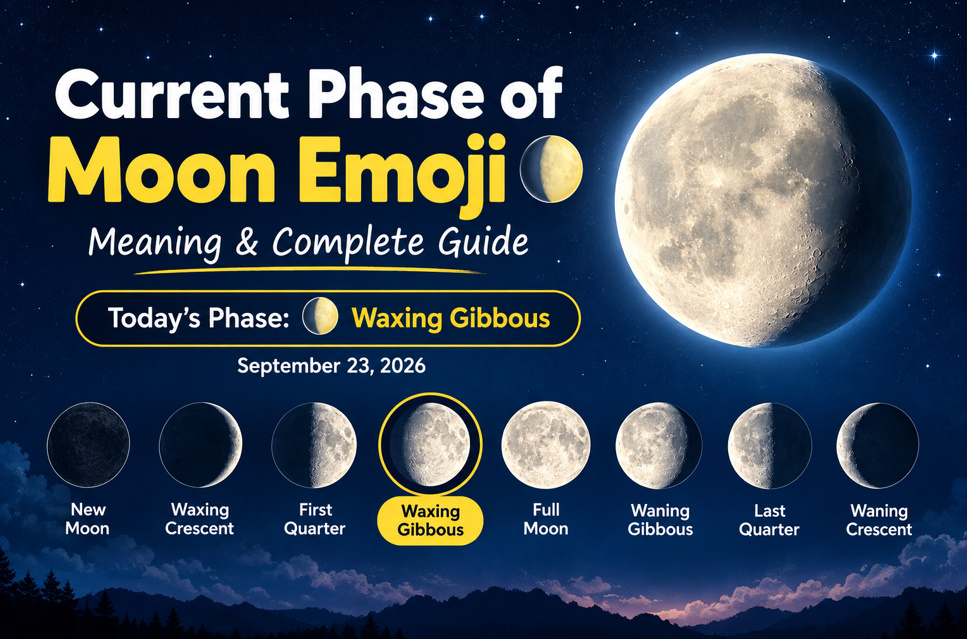
The current phase of moon emoji is a simple way to represent what the Moon looks like during its lunar cycle. Moon emojis can show different stages, from a thin crescent to a bright full moon, making them useful for astronomy, texting, captions, status updates, and social media.
The Moon goes through several recognizable phases during its approximately 29.5-day lunar cycle. On September 23, 2026, the Moon is in the waxing gibbous stage, meaning most of its visible surface is illuminated and the Moon is approaching the full Moon phase.
🌔 What Is the Current Phase of Moon Emoji?
The current phase of moon emoji usually refers to the emoji that visually represents the Moon’s present appearance. Unicode includes several moon-phase emojis, including 🌑, 🌒, 🌓, 🌔, 🌕, 🌖, 🌗, and 🌘. Each symbol represents a different stage of the lunar cycle.
For September 23, 2026, 🌔 is the closest commonly used emoji for the Moon’s waxing gibbous phase. During this stage, more than half of the Moon appears illuminated from Earth, and the illuminated portion continues increasing as the Moon approaches full phase.
- 🌑 New Moon
- 🌒 Waxing Crescent
- 🌓 First Quarter
- 🌔 Waxing Gibbous
- 🌕 Full Moon
- 🌖 Waning Gibbous
- 🌗 Third Quarter
- 🌘 Waning Crescent
🌔 What Does the Waxing Gibbous Moon Mean?
A waxing gibbous Moon occurs between the first quarter and full Moon. The word “waxing” means the illuminated portion visible from Earth is increasing, while “gibbous” describes a Moon that is more than half illuminated but not completely full.
The 🌔 emoji is therefore useful when you want to represent a Moon that is nearly full. In everyday communication, it can also suggest nighttime, beauty, mystery, peacefulness, romance, anticipation, or a dreamy atmosphere.
- 🌔 Nearly full Moon
- 🌙 Nighttime
- ✨ Beauty
- 🌌 Night sky
- 🔭 Astronomy
- 💫 Mystery
- 🌟 Wonder
- 🌠 Cosmic feeling
🌙 How Does the Moon Phase Cycle Work?
The Moon passes through a repeating sequence of phases as it travels around Earth. A complete cycle from one new Moon to the next takes approximately 29.5 days. The changing appearance happens because we see different portions of the Moon’s sunlit side from Earth.
The main lunar phases are new Moon, waxing crescent, first quarter, waxing gibbous, full Moon, waning gibbous, third quarter, and waning crescent. Moon emojis provide simple visual symbols for these recognizable stages.
- New Moon 🌑
- Waxing Crescent 🌒
- First Quarter 🌓
- Waxing Gibbous 🌔
- Full Moon 🌕
- Waning Gibbous 🌖
- Third Quarter 🌗
- Waning Crescent 🌘
🌕 Current Moon Phase vs. Full Moon Emoji
The current moon phase emoji should not automatically be confused with the full Moon emoji 🌕. A waxing gibbous Moon is already more than half illuminated, but it still has a small unilluminated portion. The full Moon represents the stage when the visible lunar disk appears completely illuminated.
When the Moon is close to becoming full, the difference between 🌔 and 🌕 can be visually subtle. However, astronomically, they represent separate phases of the lunar cycle.
- 🌔 Represents waxing gibbous
- 🌕 Represents full Moon
- 🌔 Comes before 🌕
- Illumination is increasing
- Full Moon follows waxing gibbous
- Both are lunar emojis
- Appearance changes gradually
- Each phase has a position
🔭 Why Does the Moon Change Its Appearance?
The Moon does not create its own visible light. Sunlight illuminates the Moon, and as the Moon moves around Earth, our viewing angle changes. This causes different amounts of its sunlit surface to be visible from Earth.
The Moon itself does not physically change shape during the lunar cycle. A crescent, quarter, gibbous, or full Moon is simply the result of changing positions between the Sun, Earth, and Moon.
- Sunlight illuminates the Moon
- The Moon orbits Earth
- Earth observes changing angles
- Lunar phases follow a pattern
- The Moon does not change shape
- Half of the Moon is sunlit
- Visibility changes from Earth
- The cycle repeats
📱 How to Use the Current Moon Emoji
The 🌔 emoji can be used in conversations whenever you want to communicate a lunar or nighttime theme. It works well with messages about stargazing, evening walks, astronomy, photography, peaceful nights, dreams, nature, or simply enjoying the night sky.
On social media, moon emojis can make captions more attractive and expressive. They can also work naturally with keywords and phrases such as moonlight, lunar phase, night sky, stargazing, cosmic vibes, peaceful night, and celestial beauty.
- Beautiful night 🌔
- Moon watching 🔭🌔
- Night vibes 🌔✨
- Under the moon 🌔
- Lunar night 🌌🌔
- Stargazing tonight 🔭
- Peaceful evening 🌙
- Cosmic mood ✨🌔
🌌 Moon Phase Emojis and Their Meanings
Each moon emoji visually represents a particular stage of the lunar cycle. 🌑 represents the new Moon, while 🌒 and 🌘 represent crescent stages. 🌓 and 🌗 show quarter phases, while 🌔 and 🌖 represent gibbous phases.
Moon emojis can also have informal meanings. Depending on the context, they may communicate mystery, romance, calmness, nighttime, transformation, reflection, dreams, or wonder. Their emotional meaning often depends on the words and emojis surrounding them.
- 🌑 New beginnings
- 🌒 Growing crescent
- 🌓 Half Moon
- 🌔 Almost full
- 🌕 Full Moon
- 🌖 Decreasing illumination
- 🌗 Third quarter
- 🌘 Fading crescent
📅 How to Find the Current Moon Phase
To find the current phase of the Moon, check the date and observe which stage of the lunar cycle corresponds to it. The exact appearance can also vary slightly depending on the time and location from which the Moon is observed.
For September 23, 2026, the Moon is in a waxing gibbous stage and is approaching the full Moon. Looking at the Moon’s illumination percentage, Moonrise, Moonset, and lunar calendar can help you understand its current position in the cycle.
- Check today’s date
- Select your location
- Check Moon illumination
- Identify the lunar phase
- Look at Moonrise
- Check Moonset
- Compare the emoji
- Observe the Moon
🌔 Current Phase of Moon Emoji: Quick Guide
The current phase of moon emoji provides a convenient visual way to represent the Moon’s appearance. For September 23, 2026, 🌔 is an appropriate emoji because the Moon is in its waxing gibbous stage and is approaching the full Moon.
Understanding moon phase emojis becomes easy once you know the lunar cycle. Whether you are writing an astronomy article, creating a social media caption, sending a message, or simply observing the night sky, these symbols make lunar information simple and visually appealing.
- Current phase: 🌔
- Phase: Waxing Gibbous
- More than half illuminated
- Illumination is increasing
- Full Moon comes next
- Lunar cycle is about 29.5 days
- Useful for captions
- Useful for astronomy content
Conclusion
The current phase of moon emoji 🌔 represents the waxing gibbous Moon, a stage that occurs after the first quarter and before the full Moon. During this phase, most of the visible lunar surface is illuminated, and the bright portion continues increasing.
Moon-phase emojis are more than decorative symbols. They provide a simple visual language for explaining lunar phases, nighttime moods, astronomy, nature, social media captions, and celestial themes. Once you understand the eight main Moon phases, choosing the appropriate moon emoji becomes quick and easy.