
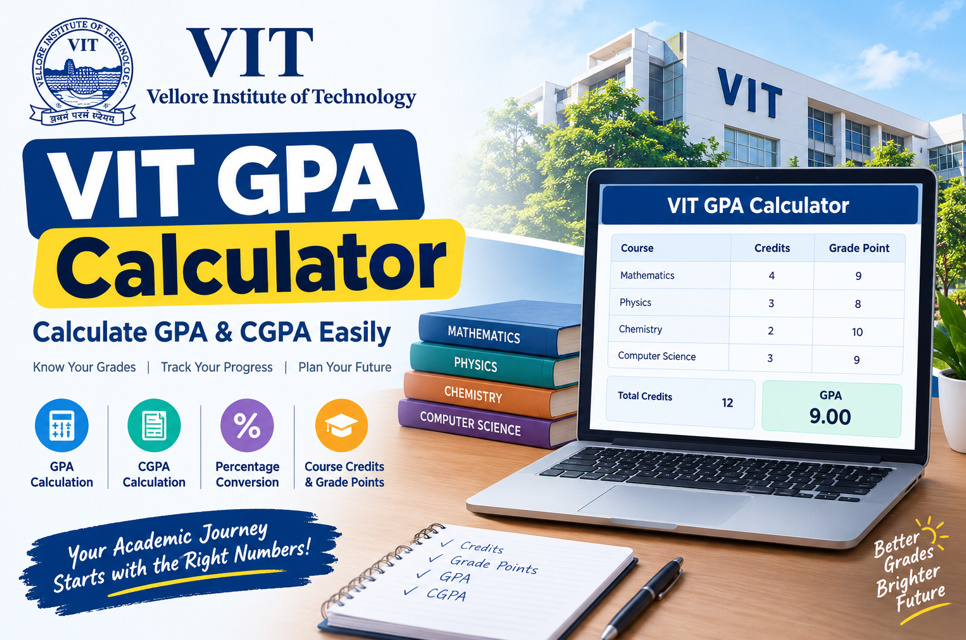
What Is a VIT GPA Calculator?
A VIT GPA calculator is an academic tool that helps students calculate their Grade Point Average using course credits and grade points. At VIT, GPA represents semester-level academic performance and is calculated as a weighted average of the grade points earned in registered courses.
Because courses can carry different credit values, simply averaging grades does not produce the correct GPA. A VIT GPA calculator handles the credit weighting automatically, making it easier for students to check semester performance, understand academic progress, and avoid arithmetic mistakes.
- Calculates semester GPA
- Uses course credits
- Uses grade points
- Applies weighted averages
- Saves calculation time
- Reduces arithmetic errors
- Helps track performance
- Supports academic planning
How Does the VIT GPA Formula Work?
The VIT GPA formula uses the credits assigned to each course and the grade points earned in that course. For every applicable course, multiply the course credit by its grade point. Add all those results and divide the total by the applicable credits registered during the semester.
The basic formula is GPA = Σ(Credit × Grade Point) ÷ ΣCredits. This credit-weighted approach means a higher-credit course contributes more to the calculation than a lower-credit course. Understanding this formula makes it easier to verify the result generated by an online VIT GPA calculator.
- Multiply credit by grade point
- Add weighted grade points
- Calculate total credits
- Divide weighted points
- Use applicable courses
- Check every entry
- Verify the final result
- Round appropriately
Understanding VIT Grade Points
Grade points are numerical values associated with the grades awarded for courses. When calculating GPA, the grade point—not simply the raw examination mark—is used in the weighted calculation. Students should therefore enter the grade actually awarded in their academic record when using a GPA calculator.
VIT’s academic regulations define the applicable grading framework and calculation rules. Since regulations can be updated, students should refer to the academic regulations applicable to their batch and programme. This is especially important when calculating GPA for official academic purposes rather than simply making a personal estimate.
- Check your awarded grade
- Use the correct grade point
- Verify academic regulations
- Avoid guessing grades
- Check your grade sheet
- Confirm course details
- Use current information
- Review unusual course categories
How to Calculate VIT GPA Manually
To calculate your GPA manually, first create a list of the courses included in the calculation. Record the credit value and grade point for each course. Multiply the two values for every course, then add the resulting grade-point-credit values. Finally, divide their total by the applicable total credits.
For example, suppose three courses carry 4, 3, and 2 credits, while their grade points are 9, 8, and 10. The calculation would be (4×9 + 3×8 + 2×10) ÷ (4+3+2) = 82 ÷ 9 = 9.11. This demonstrates the credit-weighted GPA method.
- List all applicable courses
- Record course credits
- Record grade points
- Multiply each pair
- Add weighted values
- Add total credits
- Divide the totals
- Round the answer
VIT GPA vs CGPA: What Is the Difference?
GPA and CGPA are related but measure different academic periods. GPA indicates performance for a particular semester, while CGPA represents cumulative performance from the beginning of the programme through the relevant semester. Both calculations use course credits and grade points to determine academic performance.
A VIT GPA calculator therefore focuses on the courses included in a particular semester, whereas a VIT CGPA calculator requires cumulative course information. The distinction matters when students review transcripts, academic progress, scholarship requirements, internship applications, or other situations where semester and cumulative performance may be considered separately.
- GPA is semester-based
- CGPA is cumulative
- GPA uses course credits
- CGPA uses cumulative credits
- Both use grade points
- GPA changes each semester
- CGPA accumulates over time
- Check your official grade sheet
Why Course Credits Matter in VIT GPA
Course credits determine the mathematical weight of each subject in the GPA calculation. A course with more credits contributes more strongly to the weighted average than a course with fewer credits. Consequently, entering the correct credit value is just as important as entering the correct grade point.
This is why a simple average of letter grades can give a different result from the official GPA calculation. The credit-weighted method ensures that courses contribute according to their assigned academic credits rather than treating every subject as mathematically identical.
- Credits determine weighting
- Higher-credit courses have greater weight
- Lower-credit courses have less weight
- Check registered credits
- Include applicable courses
- Avoid duplicate entries
- Verify course information
- Recalculate after corrections
How to Use a VIT GPA Calculator
Using an online VIT GPA calculator usually requires three basic pieces of information: the course, its credit value, and the applicable grade point. Enter each course carefully, check the information, and allow the calculator to perform the weighted GPA calculation.
After receiving the result, review your entries rather than immediately accepting the number. A missing course, incorrect credit value, or wrong grade point can change the result. For official academic purposes, your VIT grade sheet remains the appropriate record of your awarded GPA.
- Enter every course
- Add course credits
- Enter grade points
- Check each entry
- Review total credits
- Verify the formula
- Record the result
- Compare with official records
VIT GPA, CGPA and Percentage Conversion
GPA and CGPA are commonly presented on a 10-point scale at VIT. The percentage equivalent may be calculated according to the conversion method specified in the applicable academic regulations. Students should distinguish a percentage equivalent from the original GPA or CGPA shown on their academic record.
If an institution, employer, university, or application specifically asks for a percentage equivalent or official documentation, students should follow the current requirements. Keeping the original grade sheet and academic records is useful because these documents provide the official information needed for applications and academic verification.
- GPA measures semester performance
- CGPA measures cumulative performance
- Percentage can be an equivalent
- Check the applicable conversion rule
- Keep your grade sheet
- Check application requirements
- Verify current regulations
- Use official documentation when required
Benefits of Using a VIT GPA Calculator
A VIT GPA calculator makes academic calculations faster and easier. Instead of manually multiplying every course’s credits by its grade points, students can enter their information into a calculator and quickly obtain the weighted result. This is particularly useful when reviewing several courses in a semester.
Beyond saving time, GPA calculation can help students understand how credit weighting affects academic performance. It can also support academic record keeping and semester-to-semester comparison. However, a calculator should be viewed as a calculation aid, not a replacement for official VIT academic records or regulations.
- Saves time
- Simplifies GPA calculation
- Reduces arithmetic mistakes
- Shows credit weighting
- Helps monitor GPA
- Supports academic planning
- Makes results easier to understand
- Useful for semester tracking